I did not arrive at this idea from a spreadsheet.
I arrived at it after years of watching families confront the same practical question: when an older adult can no longer live safely at home, how will the next chapter be paid for?
The senior housing industry usually approaches middle-market affordability from the cost side. We debate land, construction, labor, services, capital and margins. Those discussions are necessary. But there is another side of the equation that deserves equal attention: the resources older adults already possess.
For millions of older Americans, the largest retirement asset is not held in a brokerage account. It is the house.
The Equity Already Exists
Housing wealth among homeowners age 62 and older reached a record $14.92 trillion in the first quarter of 2026, according to the NRMLA/RiskSpan Reverse Mortgage Market Index. That figure is national and unevenly distributed, but its scale matters. It represents accumulated value that is often substantial even when an older household has limited liquid savings.
The Urban Institute found that inflation-adjusted median home equity among cost-burdened homeowners age 62 and older increased from $173,000 in 2019 to $222,000 in 2022. For many households, the home is not simply shelter. It is the balance sheet.
The National Association of REALTORS® has projected that the national median home price, approximately $430,000 in 2026, could reach $1 million in about 25 years under several long-term appreciation scenarios. That is not a promise, and no family should build a care plan around a single forecast. But it highlights a durable reality: housing wealth is likely to remain central to retirement security and long-term care planning.
The Analytics Confirm the Field Observation
NORC at the University of Chicago projects that the United States will have approximately 16 million middle-income adults age 75 and older by 2033. Excluding home equity, nearly three-quarters would lack sufficient financial resources to pay for private assisted living if they needed and wanted it. Even after home equity is included, nearly 40 percent would still be unable to afford it.
That finding should not be read as evidence that home equity solves the middle-market problem. It does not. It does, however, show that including the home materially changes the affordability equation for a large portion of the market.
Earlier research sponsored by the National Investment Center for Seniors Housing & Care reached a similar conclusion. NIC estimated that reducing annual senior housing costs from $60,000 to $45,000 could expand the potential middle-market population able to afford care by approximately 3.6 million people age 75 and older when housing equity is included.
Explore the NIC Senior Housing Affordability Calculator: nic.org/affordability-calculator
Who This Article Is About
NIC defines the middle market as individuals between the 41st and 80th percentiles of income and annuitized assets. These older adults sit between two imperfectly defined ends of the market.
At one end are higher-income households that can absorb traditional private-pay senior housing rates. At the other are lower-income individuals who may qualify for Medicaid or other state-supported programs, although eligibility, services and availability vary significantly by state.
The middle group may have Social Security, a modest pension, limited savings and a home that has appreciated over decades. They may not have enough monthly income to pay prevailing assisted-living rates indefinitely. But they are not necessarily without resources.
This is not an argument for forced liquidation, Medicaid spend-down planning or treating the home as a pool of money that providers are entitled to access. It is about voluntary asset conversion when a homeowner or family determines that a move is necessary and the home is no longer required for a spouse or dependent.
Senior Housing Demand Is Often Need-Driven
The transition into assisted living is frequently precipitated by cognitive or functional decline rather than lifestyle preference alone. Missed medications, inadequate nutrition or hydration, falls, isolation and the loss of the ability to manage daily routines can make living alone unsafe.
National data from the Centers for Disease Control and Prevention show that 44 percent of residential-care residents had a diagnosis of Alzheimer disease or another dementia in 2022. Seventy-five percent needed assistance with bathing, 71 percent with walking and 62 percent with three or more activities of daily living.
These numbers reinforce what operators see in the field. Assisted living is not simply an apartment with meals. It is housing combined with personal assistance, medication oversight, nutrition, social engagement and continuous watchfulness so that changes in a resident's condition can be recognized and addressed.
When the House Becomes Available
Home equity is not always immediately accessible. If one spouse remains in the home, selling may be inappropriate or impossible. Some couples move into senior housing together; others do not. Every family arrangement is different.
Yet many older adults enter senior housing after a spouse has died and the household has already become a one-person household. Women are especially likely to face this transition. Federal aging data show that 42 percent of women age 75 and older lived alone in 2023, while CDC data show that approximately two-thirds of residential-care residents were women.
In those circumstances, the home may become available for sale. Proceeds can then be combined with Social Security, pension income, savings, long-term care insurance or family support. The home does not have to fund every dollar of care to change the outcome. It may only need to close the gap.
The Overlooked Assets in Secondary and Tertiary Markets
The home-equity discussion should not be limited to affluent suburbs or expensive coastal markets. Many older adults in secondary and tertiary markets own smaller conventional homes, modular homes or manufactured homes that have appreciated over time.
A modest asset can still be meaningful when measured against a defined period of care. Manufactured housing requires particular care in the analysis because the resident may own the home but lease the land, and titling and resale economics vary. Modular homes are generally treated as real property, while manufactured homes may be titled differently depending on the state and whether the underlying land is owned.
The correct conclusion is not that every manufactured home contains usable equity. It is that these homes should not be dismissed automatically. Ownership, debt, land tenure, local demand and transaction costs must be evaluated household by household.
Converting Equity Into Care
The 2025 national median cost of assisted living was approximately $6,200 per month, according to CareScout. Medicare generally does not pay for long-term custodial care, which means families often rely on private resources, long-term care insurance or state programs.
Now consider a credible middle-market assisted-living model priced between $4,000 and $4,500 per month in today's dollars. That model would still need to provide housing, meals, personal assistance, medication oversight, activities and watchful support. Over a two-year period, the gross cost would be approximately $96,000 to $108,000 before applying Social Security, pension income or other monthly resources.
For a homeowner with meaningful equity - even in a modest home - those proceeds can materially extend the period during which quality assisted living is affordable. The mathematics improve further when recurring income pays part of the monthly expense and home-sale proceeds fund only the remaining shortfall.
Affordability Has Two Sides
Resident-side liquidity is only half of the solution. The operator must still create a product at a sustainable price.
The care requirements do not become less expensive merely because a resident has less income. Regulations, staffing, food, medication management, insurance, utilities and resident acuity remain. An operator cannot build a durable middle-market model by simply removing needed services or staffing below the level required to support residents safely.
Affordability must therefore be engineered into the basis and operating model: disciplined acquisition, adaptive reuse where appropriate, efficient design, responsible capital, thoughtful procurement, technology that supports staff and consistent execution.
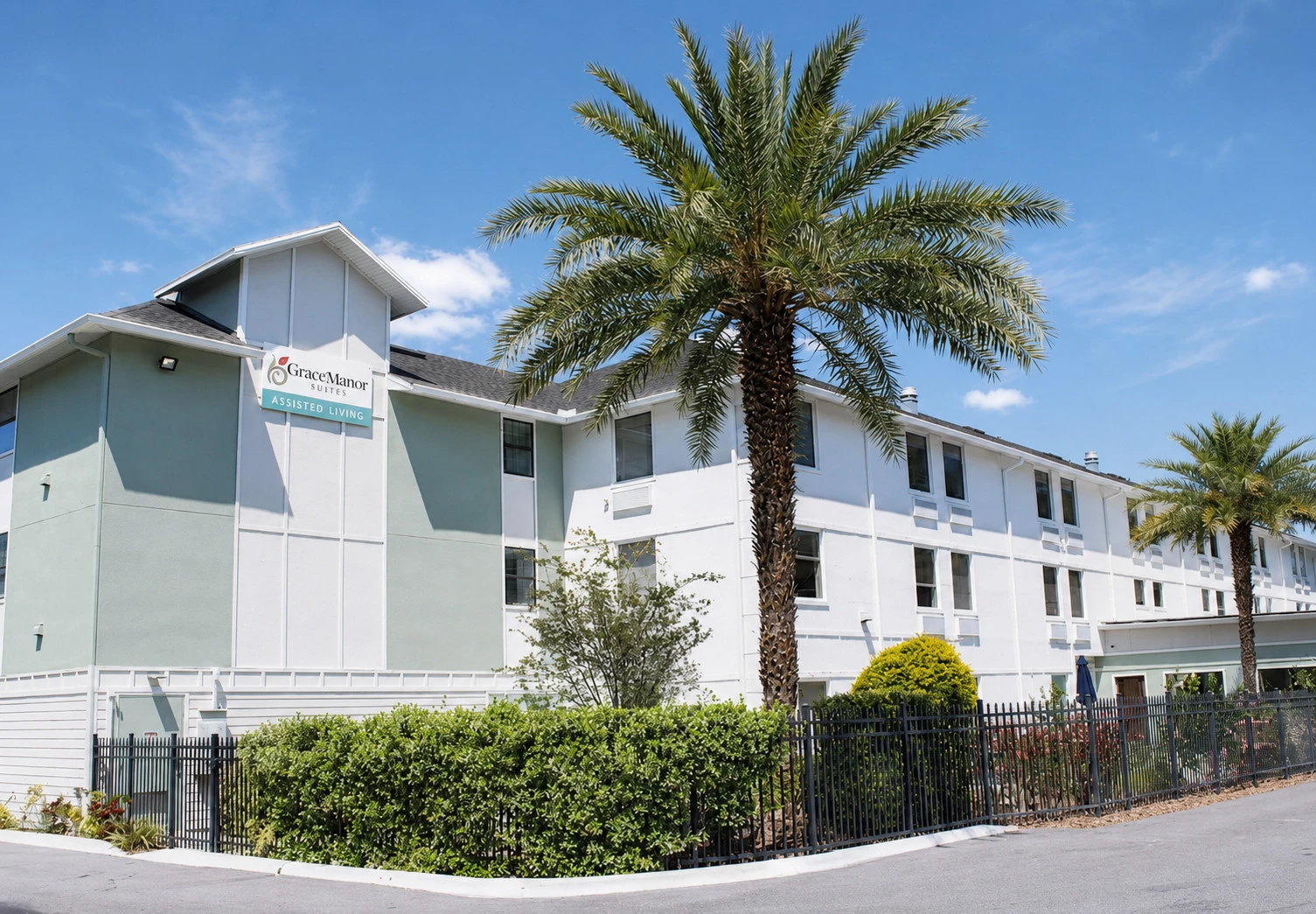
Grace Manor Suites in Lakeland, Florida, is a three-story, 68-unit assisted-living community created through the conversion of a former hotel. It does not represent a universal formula, but it demonstrates the kind of adaptive-reuse thinking the industry must continue exploring. The resident-side question is how families can access resources. The operator-side question is how we deliver the necessary service without allowing the real estate and capital structure to consume too much of those resources.
What Home Equity Cannot Solve
Home equity does not help renters. It may offer little assistance to households with substantial mortgage debt, limited appreciation, complicated ownership or a spouse who must remain in the home. It may not be sufficient for prolonged, high-acuity care. Housing values can also decline, and selling costs reduce net proceeds.
That is why this thesis should be treated as one component of a broader affordability strategy - not as a substitute for public policy, insurance, savings, family support or more efficient senior housing models.
But rejecting home equity because it is not universal would overlook one of the largest financial resources available to older Americans.
A Final Thought
The insight begins with conditions on the ground: families confronting a need-driven move, operators trying to preserve service quality and a large middle market caught between public support and traditional private-pay pricing.
The analytics tell us the idea is worth pursuing.
The home is not the answer to everything. But for millions of older homeowners, it may be part of the care plan - and one worth designing around.
Sources and Further Reading
National Association of REALTORS®. NAR Chief Economist Lawrence Yun Says Home Sales Expected to Improve in Second Half of 2026
NRMLA/RiskSpan. Senior Home Equity Surges to Record $14.92 Trillion in Q1 2026
NORC at the University of Chicago. The Forgotten Middle in 2033
National Investment Center for Seniors Housing & Care. Middle Market Executive Summary
National Investment Center for Seniors Housing & Care. NIC Senior Housing Affordability Calculator
Urban Institute. Expanding Access to Home Equity Could Improve the Financial Security of Older Homeowners
Centers for Disease Control and Prevention. Residential Care Community Resident Characteristics: United States, 2022
Administration for Community Living. 2023 Profile of Older Americans
Medicare.gov. Long-Term Care Coverage
CareScout. Cost of Care Survey
The Pew Charitable Trusts. How to Improve and Expand Ownership of Manufactured Homes
About the Author
Tod Petty serves as Chief Investment Officer at Mainstay Financial Services and Mainstay Senior Living. Drawing on more than two decades of experience as a president, COO, CEO and chief investment officer, he writes about the intersection of capital, operations, leadership and strategy in senior housing and healthcare real estate.