Senior housing demand is often discussed through familiar categories: age bands, income levels, household counts, home values, adult child demographics, care needs, and competitive supply. Those measures matter, and they should remain central to market analysis.
But they do not tell the full story.
A market can look attractive on paper and still behave differently than expected. That is because the decision to move into senior housing is rarely driven by age alone. It is shaped by family patterns, local identity, trust, healthcare access, lifestyle preferences, independence, and the emotional meaning of home.
That is why place attachment deserves more attention.
A recent map by Todd R. Jones illustrates this idea in a simple but meaningful way. Using U.S. Census Bureau ACS data, the map shows the percentage of residents in each state who still live in the same state where they were born.
At first glance, it is a demographic map. For senior housing investors and operators, it points to a deeper question: how do people relate to place as they age?
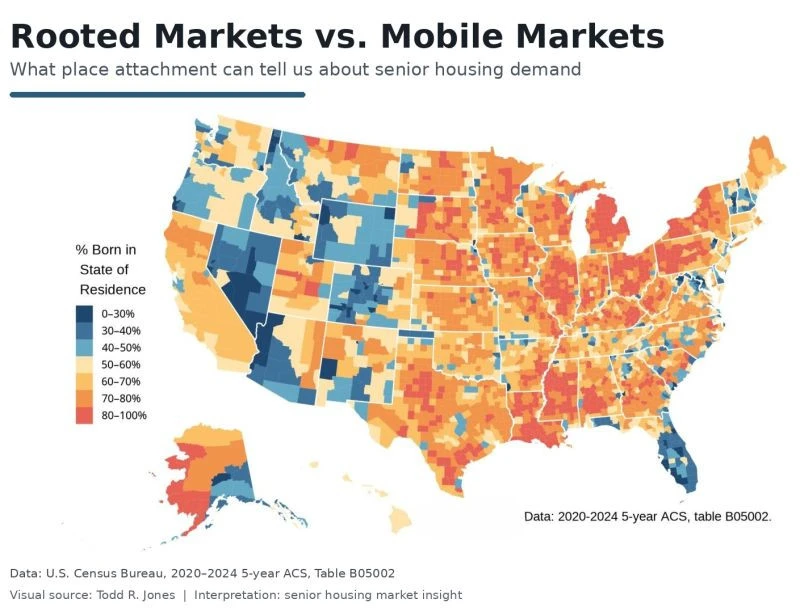
In some markets, residents are deeply rooted. They may have lived in the same region for most of their lives. Their adult children may still be nearby. Their physicians, pharmacists, churches, friends, civic relationships, and daily routines may all be local.
In these markets, a senior housing decision is often less about leaving home and more about preserving continuity within a familiar community.
That changes how investors and operators should think about the opportunity. In a rooted market, trust carries tremendous weight. Reputation matters. Local leadership matters. Word of mouth matters.
The community needs to feel like it belongs to the market, not like it was imported into the market. Sales strategy, programming, dining, referral development, local partnerships, and family communication should reflect the culture and relationships already present.
Other markets behave differently.
In more mobile markets, older adults may be relocating to be closer to adult children, access better healthcare, enjoy warmer weather, reduce home maintenance, or pursue a different lifestyle. These residents may not be moving across town. They may be starting over in a meaningful way.
For them, senior housing is not only a care or housing transition. It may also be a social and emotional transition into an unfamiliar place.
That creates a different operating challenge. In a mobile market, a community may need to create belonging more quickly and more intentionally. Hospitality, onboarding, social integration, family communication, lifestyle programming, and resident engagement become especially important.
The first several weeks after move-in may carry outsized importance because the resident is not simply adjusting to a new apartment. They may be rebuilding connection, routine, identity, and confidence.
Both types of markets can be attractive. But they are not the same opportunity.
A rooted market may require a strategy built around continuity, reputation, local relationships, and cultural familiarity. A mobile market may require a strategy built around welcome, integration, communication, and intentional community formation.
One market may reward deep local trust. Another may reward the ability to help residents and families feel known quickly.
This is where demographics and psychographics need to work together.
It is not enough to know how many seniors live in a market or how many households can afford private pay senior living. Investors and operators also need to understand how people make decisions about place, family, independence, care, identity, and belonging.
Better market evaluation asks better questions.
Are older adults aging in place? Are they relocating into the market? Are adult children nearby? Is the local culture deeply established, regional, or largely imported? Does a community need to preserve belonging, create belonging, or both?
These questions matter because senior housing is not only a real estate investment category. It is an operating business built around human transition.
People move into senior housing because something in life has changed. A spouse may have passed away. A home may have become too much to manage. Adult children may be concerned. Loneliness may have become heavier. Medication routines, nutrition, mobility, or safety may require more support.
The family may need confidence that care and community are both present.
Every one of those decisions happens in the context of place.
That is what makes this map useful. It does not provide all the answers, and it should not be treated as a standalone investment tool. But it does remind us to look beneath the surface of demographic demand.
It invites better questions about how people attach to place, how families make decisions, and how different markets may require different operating strategies.
The senior housing opportunity ahead remains significant. The demographic story is real, and the need for quality housing, care, and community will continue to grow.
But the strongest operators and investors will look beyond age bands and income levels. They will study the behavioral patterns underneath the data and recognize that demand is not created by age alone.
Age may define the addressable market. Behavior shapes the actual opportunity. And place attachment may be one of the most important demand signals we are not talking about enough.
At Mainstay Financial, we believe senior housing investment requires both demographic discipline and operational insight. Durable value is rarely created by numbers alone. It is created when the numbers are understood in light of the people, families, communities, and operating realities they represent.
Place matters. Belonging matters. Behavior matters.
In senior housing, the communities that understand all three will be better positioned to serve residents, support families, and create durable long-term value.
---
About the Author: Tod Petty serves as Chief Investment Officer at Mainstay Financial Services & Mainstay Senior Living, where he leads capital strategy, investor alignment, and portfolio growth across an operationally informed senior housing platform. With more than three decades of experience as an owner, operator, and executive, he focuses on disciplined acquisitions, resilient middle-market communities, and capital structures designed to perform across cycles. Tod is also the creator of The Clarity Brief™.