The senior housing industry has spent years documenting its demographic opportunity. The population of older adults continues to grow, occupancy has strengthened, and new construction remains constrained. For investors and operators, these fundamentals suggest a substantial need for additional senior housing capacity over the coming decade.
Yet the demographic outlook does not answer an equally important question: Can we deliver housing and care at a price middle-income older adults can sustain while maintaining the quality and financial stability necessary to operate these communities over time?
The housing affordability conversation often centers on the need for additional supply. But increasing supply does not necessarily address affordability when the cost of delivering new housing exceeds what households can reasonably pay. Senior housing faces an even more complicated equation because we are not simply providing a place to live. We are providing housing, hospitality, meals, personal care, and services that depend heavily on people.
The challenge is finding a sustainable balance between what residents can afford, what communities cost to operate, and the capital required to acquire, improve, or develop them.
Demand Is Strong. Access Is a Different Measure.
Senior housing occupancy continues to demonstrate the strength of underlying demand. According to the National Investment Center for Seniors Housing & Care (NIC), occupancy reached 90.4% in the third quarter of 2026 across the markets included in its reporting. With limited new construction and a growing population of older adults, the industry faces increasing pressure to expand available housing and care options.
However, occupancy is only one measure of market demand. It tells us how existing communities are performing, but it does not tell us how many older adults need senior housing and cannot afford the available options. Strong occupancy and a significant affordability gap can exist simultaneously.
This distinction is particularly important for the population commonly described as the Forgotten Middle. Research conducted by NORC at the University of Chicago, with support from NIC, identified a growing segment of middle-income older adults who may have too many financial resources to qualify for traditional public assistance programs but insufficient resources to sustain conventional private-pay senior housing.
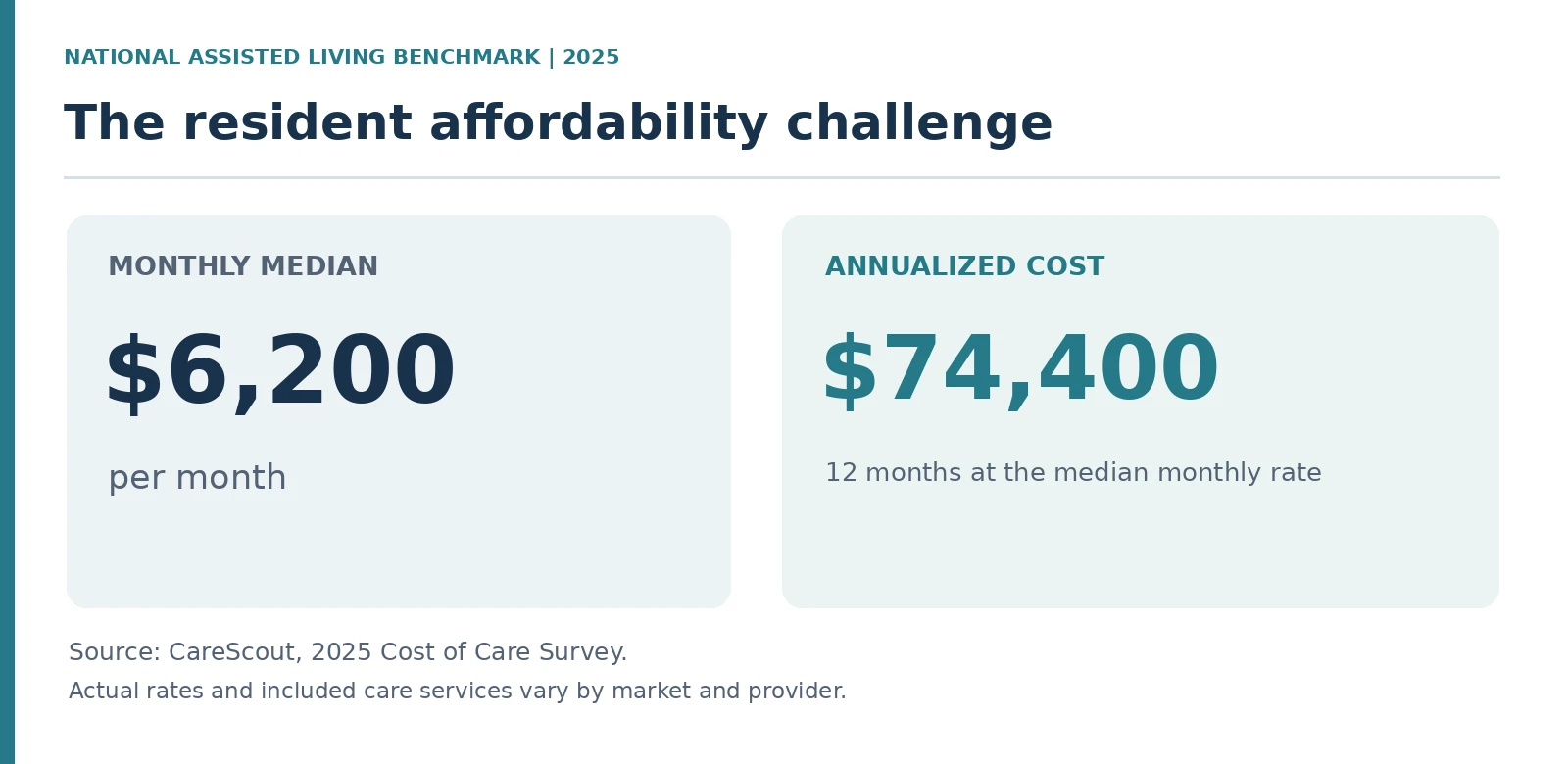
National median assisted living cost: $6,200 monthly, or $74,400 annually. Source: CareScout, 2025 Cost of Care Survey.
The challenge becomes apparent when we examine the cost of assisted living. CareScout's 2025 Cost of Care Survey reported a national median assisted living cost of approximately $6,200 per month, equivalent to $74,400 annually. Although rates vary by geography, service level, and apartment configuration, the national benchmark illustrates the financial commitment confronting many older adults and their families.
For residents and families, affordability extends beyond the initial monthly rate. Retirement income, savings, home equity, and other financial resources must support housing and care over an uncertain period. Care needs may increase, financial circumstances can change, and the length of residency cannot always be anticipated.
A sustainable middle-market solution must consider that entire financial journey rather than simply the cost of entering a community. The need for senior housing may be substantial, but that does not necessarily mean households have sufficient resources to support the product being delivered.
This is where the demographic opportunity and the affordability challenge begin to diverge. The industry must understand not only how many older adults are likely to need housing and care, but also what level of services those households can afford over time.
Development Costs Constrain the Options
The affordability challenge begins long before a resident moves into a community. Land acquisition, construction costs, financing, regulatory requirements, insurance, and development expenses establish a substantial capital investment that must ultimately be supported by the property's operating performance.
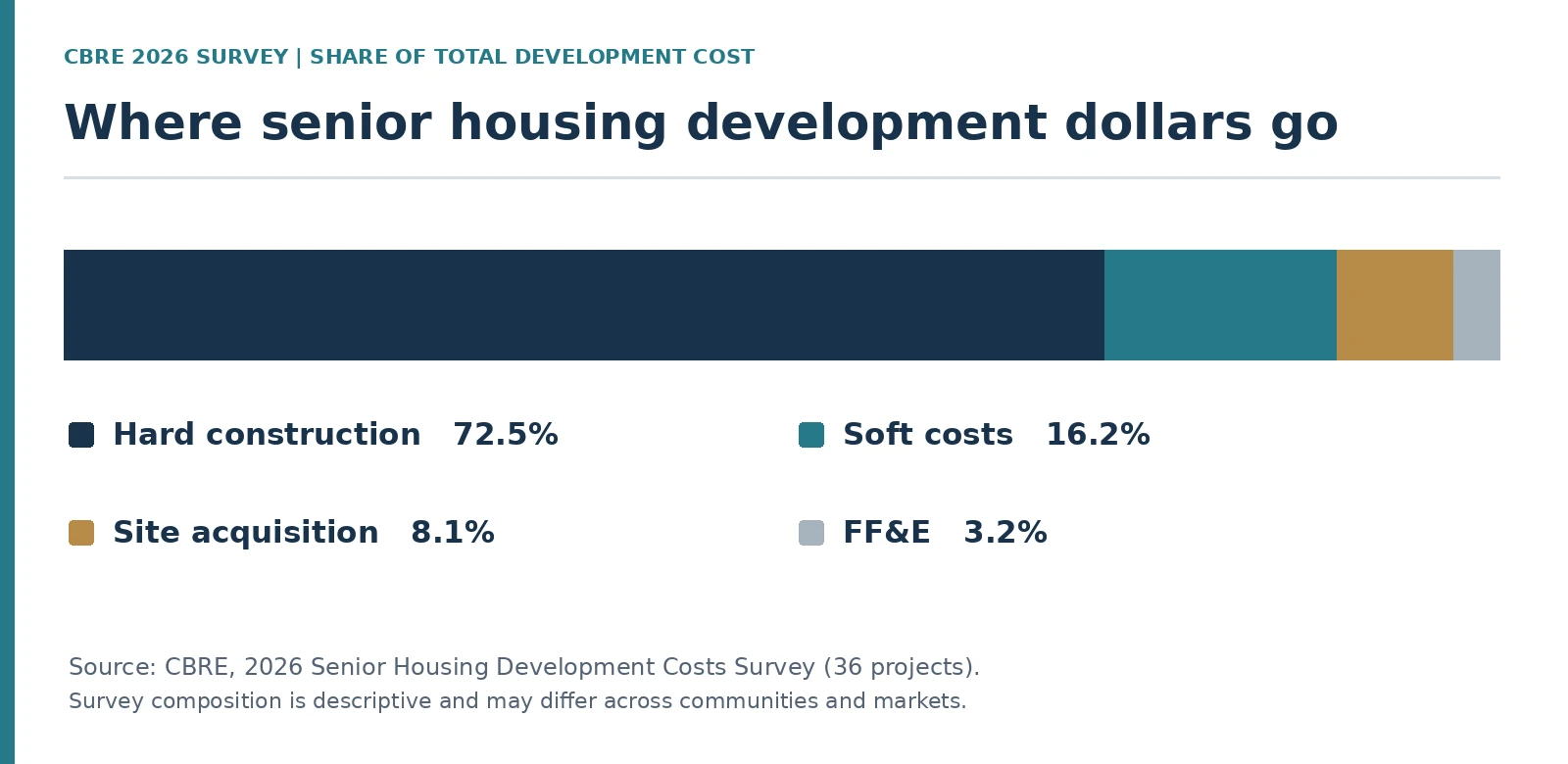
CBRE's 2026 Senior Housing Development Costs Survey, covering 36 developments, reported an average total development cost of approximately $388,830 per revenue unit. Although individual projects vary considerably, the findings illustrate the capital required to deliver new senior housing inventory.
Hard construction costs represented approximately 72.5% of total development expenses within the surveyed projects. Site acquisition, soft costs, and furniture, fixtures, and equipment accounted for the remaining investment. These costs are incurred before a community reaches stabilized occupancy and generates the operating income required to support its financial obligations.
The implications extend beyond the development budget. Once a community opens, it must generate sufficient revenue to support staffing, meals, resident services, utilities, insurance, maintenance, debt obligations, and ongoing capital improvements. Those requirements establish a financial threshold that resident rates must ultimately support.
This helps explain why much of the industry's new development activity has focused on higher-end private-pay communities. The combination of development costs and operating requirements can make it difficult to support more attainable resident rates while achieving the financial performance necessary to attract investment capital.
Reducing monthly rates without addressing the underlying development and operating economics does not resolve the problem. It simply transfers financial pressure to another part of the investment.
For the middle market, the challenge is not identifying demand. It is finding a development and operating model capable of serving that demand sustainably.
Acquisition Can Create Flexibility, but the Investment Basis Matters
While additional development will be necessary to address future demand, the existing senior housing inventory represents another opportunity worth examining.
Acquiring and repositioning an existing community can provide a different starting point than constructing a new property. Land, infrastructure, common areas, and much of the physical plant are already in place. When an asset can be acquired at an appropriate valuation, investors may be able to direct capital toward improvements, operating stabilization, and resident services rather than absorbing the full cost of new construction.
However, acquiring below replacement cost does not automatically create an attractive investment or an attainable senior housing solution. Older communities may carry significant deferred maintenance, inefficient building configurations, outdated mechanical systems, life-safety requirements, or operating challenges that require substantial additional investment.
An attractive purchase price can quickly lose its advantage when the full cost of ownership is considered.
At Mainstay, we approach these opportunities by evaluating the real estate and the operating business together. Acquisition price, required capital improvements, resident demand, achievable rates, staffing requirements, financing obligations, and future operating performance must support the same investment thesis.
An attractive acquisition basis is not enough if the community cannot deliver consistent care, maintain its physical condition, and generate sustainable operating cash flow.
This integrated approach becomes particularly important in senior housing because the investment cannot be separated from the daily operations of the property. The financial performance of a community ultimately depends on what happens inside the building.
Operating Discipline Is Part of the Affordability Solution
Senior housing is an operating business within a real estate investment. The quality of leadership, staffing, resident services, and daily execution directly influences both the resident experience and the financial performance of the property.
Labor represents one of the most significant operating considerations. Communities depend on qualified team members to provide care, supervision, dining services, housekeeping, maintenance, and other essential functions. These services are fundamental to what residents and families expect when choosing senior housing.
That creates an important distinction between operating efficiency and simply reducing expenses.
Operating efficiency begins with designing communities and service models around actual resident needs. Appropriate staffing patterns, effective care assessments, thoughtful purchasing, preventive maintenance, and strong community leadership can improve financial performance while protecting the resident experience.
These disciplines require consistent execution rather than simply a lower-cost building.
In my experience, operating performance often reflects decisions made long before a financial statement reveals the results. Staffing stability, employee engagement, maintenance conditions, resident satisfaction, and local leadership all influence occupancy, expenses, and long-term asset performance.
For investors, these are not secondary operating considerations. They are fundamental components of underwriting, capital allocation, and risk management.
A community acquired at an attractive valuation can still struggle financially if the operating model is inefficient or the property requires substantial reinvestment. Conversely, thoughtful operational improvements can strengthen an existing community's performance while preserving the quality of services residents depend upon.
The objective should not be to deliver less care for less money. It should be to create an operating model that directs resources toward the services residents need while maintaining financial sustainability over time.
What This Means for Investors and Capital Partners
The senior housing investment opportunity is supported by favorable demographic fundamentals, but those fundamentals do not eliminate the need for disciplined underwriting.
Strong demand does not compensate for an unsustainable capital structure, an inappropriate resident price point, or an operating model that cannot deliver consistent services at a reasonable cost.
Investors must evaluate the relationship between household resources, local market conditions, achievable resident rates, replacement costs, capital requirements, and operating performance.
Each market presents a different combination of opportunities and constraints. Some locations may support new development through thoughtful design and efficient construction. Others may offer better opportunities through acquisition, renovation, or repositioning. Still others may lack the household resources or operating conditions necessary to support a sustainable middle-market strategy.
Understanding those differences is essential.
Replacement cost can provide useful context when evaluating an acquisition, but replacement cost alone does not establish investment value. The true investment opportunity depends on total invested capital, sustainable cash flow, local demand, and the operator's ability to execute.
For capital providers, lenders, and owners, the affordability challenge therefore requires a broader perspective than traditional supply-and-demand analysis. It requires evaluating whether the investment structure, physical asset, resident market, and operating model can work together over the long term.
The Measure of Progress Is Sustainable Access
The next chapter of senior housing will require more than adding communities to meet population growth. It will require careful consideration of what older adults can afford, what communities cost to develop or acquire, and what operators must invest to deliver dependable care.
At Mainstay, we believe these considerations belong in the same investment decision. Acquisitions, development, capital improvements, and daily operations cannot be evaluated independently when the objective is long-term sustainability.
Meeting the needs of middle-income older adults will require innovation, disciplined investment, and a willingness to reconsider traditional development and operating assumptions. No single strategy will close the affordability gap in every market, and no capital structure can eliminate the risks associated with operating senior housing.
The opportunity is substantial, but the measure of progress should extend beyond occupancy and unit growth.
Ultimately, the industry's success will depend not simply on how many units we develop or acquire, but on how many older adults we can serve responsibly and sustainably over time.
Sources and Further Reading
The following research informed the analysis presented in this article.
National Investment Center for Seniors Housing & Care (NIC). Senior Housing Occupancy Nears Record High as Majority of Markets Surpass 90%. October 2026.
NIC / NORC at the University of Chicago. The Forgotten Middle: Middle Market Seniors Housing Study. 2019.
CareScout. 2025 Cost of Care Survey. National assisted living cost data.
CBRE. 2026 Senior Housing Development Costs. July 2026.
Walker & Dunlop / Zelman. Why the U.S. Housing Shortage Is Really a Price-Point Problem. June 2026. Research examining housing affordability, development costs, and the distinction between housing supply and attainable housing.
About the Author
Tod Petty | Chief Investment Officer, Mainstay Financial Services
Tod Petty serves as Chief Investment Officer at Mainstay Financial Services, bringing more than 20 years of executive leadership experience across senior housing, healthcare real estate, capital strategy, and operations.
Having served as President, Chief Operating Officer, and Chief Executive Officer of senior housing organizations, Tod brings an integrated perspective to investment decisions, connecting real estate fundamentals with the operational realities of providing housing and care for older adults.
He is the author of Senior Housing Unfiltered, where he explores the relationship between capital, leadership, operating execution, and the long-term future of senior housing.
Editorial and Investment Disclaimer
This article is provided for general educational and informational purposes only and does not constitute investment advice, an offer to sell, or a solicitation of an offer to buy securities or any investment product.
Any securities offering, if made, will be conducted only through applicable formal offering documents and in accordance with relevant securities laws.
Industry statistics, research findings, and projections are identified by their respective sources and reporting periods. Such information is subject to change and should not be interpreted as a guarantee of future performance or results.
Development costs, operating performance, resident rates, and investment outcomes vary by market, property type, financing structure, and other circumstances.
Real estate investments involve risks, including the potential loss of principal. Past performance is not indicative of future results. Prospective investors should review applicable offering materials and consult their own legal, tax, and financial advisers before making investment decisions.